Why Wood Slat Divider Spacing Matters More Than You'd Think
Most people shopping for a wood slat room divider spend their time comparing finishes, walnut against white oak, paintable MDF against pre-finished veneer, and choosing a length that fits their wall. Those decisions matter, but they're not the ones that determine how the divider actually behaves in daily life. That comes down to wood slat divider spacing: the gap left between each vertical slat.
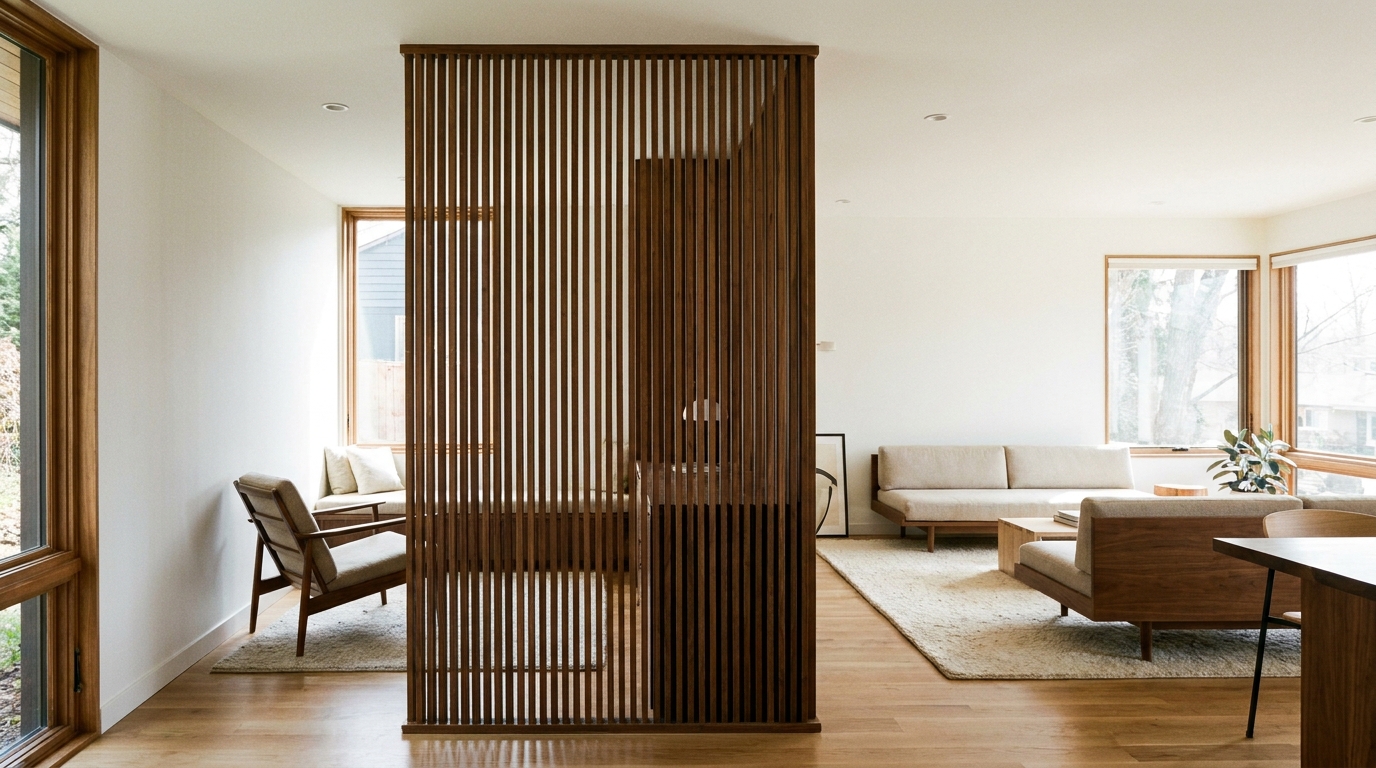
Spacing is the quiet variable that decides how much of the room beyond stays visible, how much daylight passes through, and how the whole piece reads from across the room. Two dividers built with identical slats, in the same finish, at the same height, can feel like completely different products depending on whether the gaps between them are half an inch or two and a half inches. Getting this right before you order is the difference between a divider that solves your privacy problem and one that just adds a decorative line down the middle of your open floor plan.
How Gap Width Changes Light and Privacy
Slat spacing sits on a spectrum, and where you land on it is really a trade-off between two things: how much you want to see through the divider, and how much light and airiness you want to keep.
Tight spacing (around 3/4" to 1") narrows sightlines significantly. From most angles in the room, the space is visually screened off, which is what you want for a home office that needs to feel separate from a living area, or a primary bedroom you're carving out of a larger open-plan space. Light still filters through, since wood slats are never a solid wall, but the divider reads as a more defined boundary.
Medium spacing (around 1.5" to 2") is the middle ground most living rooms land on. It creates a clear zone break, the kind of "this is the reading nook, that's the dining area" separation open-concept homes are usually built for, while still letting light and a sense of connection pass between the two sides. Most of Primo Panels' installed rooms use spacing in this range because it balances definition with airiness.
Wide spacing (2.5" and up) leans decorative. At this width, a divider stops functioning as a privacy screen and starts functioning more like a rhythmic architectural feature, think staircase railings, entryway statement walls, or a soft visual cue between a kitchen and dining area where you're not trying to hide anything, just add structure and warmth to the sightline.
None of these are "correct." They're tools, and the right one depends entirely on what problem you're solving in that specific room.
Spacing and the ROTERA vs. FIXERA Decision
Gap width doesn't exist in isolation, it interacts directly with which slat system you choose. FIXERA slats are mounted in a fixed position, so whatever spacing you select at the time of installation is what you'll live with permanently. That makes FIXERA a good fit once you're confident about how much privacy a room needs, since you're not planning to adjust it later.
ROTERA slats rotate on their axis, which means the physical gap between slats stays the same but the effective opening changes as you turn them, from nearly closed to fully open. If you're on the fence about how much visibility you want, ROTERA gives you a way to hedge: order a moderate gap width and use the rotation to fine-tune light and privacy day to day, rather than trying to lock in the perfect spacing up front.
Matching Spacing to the Room
Home offices and bedrooms built out of open-plan space generally call for tighter spacing. These are rooms where the goal is genuine visual separation, not just a design accent, so narrower gaps do more of the work.
Living rooms and dining areas tend to do best with medium spacing. You're usually zoning, not hiding, so a gap width that keeps the room feeling connected while still marking a clear boundary tends to look and function best.
Staircases, entryways, and accent applications can handle wider spacing since the divider's job there is closer to architectural detail than privacy screen. A wider gap also shows off more of the actual wood grain and cross-section profile at once, which matters when the divider is meant to be a visual feature in its own right.
Acoustic considerations are worth a mention too. Tighter spacing with a thicker cross-section, such as a 2"x6" profile instead of the standard 2"x4", breaks up sound reflections slightly more than wide, shallow slats. A wood slat divider will never perform like a solid wall acoustically, but spacing and profile depth both play a small role in how much sound diffusion you get.
Working the Numbers With the Build and Price Tool
Because spacing directly affects how many slats a given wall width requires, it also affects final cost. Tighter gaps mean more slats to fill the same span; wider gaps mean fewer. Primo Panels' Build and Price Your Divider tool lets you enter your wall width, ceiling height, finish, system (ROTERA or FIXERA), and desired gap spacing, and it returns an exact slat count and price, so you can compare a tight-spacing plan against a wide-spacing one for the same wall before committing to either.
This is also the easiest way to sanity-check a spacing decision against your budget. If a 1" gap prices out higher than you expected for a 10-foot wall, bumping to 1.5" or 2" often brings the slat count, and the total, down without meaningfully changing how the room feels.
Getting It Right the First Time
Because Primo Panels dividers are a permanent, professionally installed architectural feature rather than a piece you can casually swap out, spacing is one of the few decisions worth slowing down on before you order. Think about what the divider actually needs to do in that room, block sightlines, filter light, or just add texture, and let that answer drive the gap width rather than starting from an aesthetic preference alone.
If you're unsure where to land, Primo Panels' team can walk through your room's specific goals and recommend a spacing range before you finalize an order at primopanels.com, so the divider you install is sized right the first time.