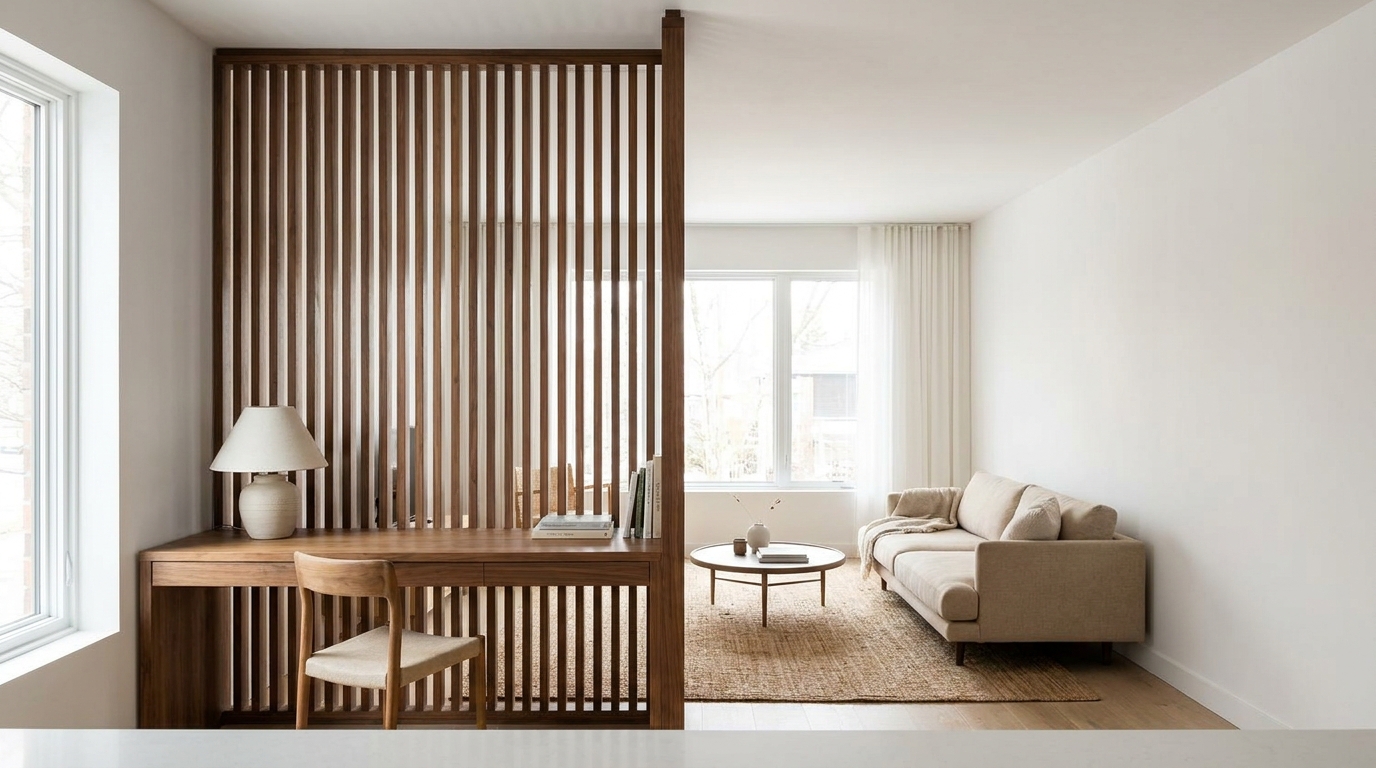
Choosing a wood slat divider system is a decision most homeowners don't realize they need to make until they're standing in front of a spec sheet. Beyond finish and slat width, every Primo Panels divider is built on one of two systems: ROTERA, with slats that rotate on a vertical axis, or FIXERA, with slats permanently fixed in place. Both are professional-grade, both install as a permanent architectural feature, and both look nearly identical in a photo. The difference only shows up once the divider is doing its job in your actual room.
This guide breaks down what ROTERA and FIXERA actually do differently, which rooms and use cases suit each one, and how to think through the decision before you build and price your own divider.
What ROTERA and FIXERA Actually Are
Both systems use the same real wood veneer or paintable MDF slats, mounted floor-to-ceiling as a permanent architectural feature rather than a temporary or free-standing screen. The systems differ in how the individual slats behave once installed.
FIXERA slats are set at a fixed angle and stay there. Once installed, the sightline through the divider — how much you can see from one side to the other — is locked in for good. It's the simpler of the two systems mechanically, which is part of why it reads as the cleaner, more architectural option: a continuous, uninterrupted line of slats with no visible adjustment hardware.
ROTERA slats pivot on a vertical axis, so the gap between each slat can be opened or closed after installation. Turn the slats one way and the divider reads as nearly solid, with minimal sightline through; turn them the other way and it opens up considerably, letting more light and visual connection pass between the two zones it separates.
Neither system is retrofit-only or reversible after the fact — the choice is made at the time you build and price your divider, so it's worth thinking through your room's actual daily use before ordering.
When FIXERA Makes More Sense
FIXERA suits rooms where the divider's job is mostly done once — you know what angle you want, and you don't expect that to change month to month.
Consistent Zoning Without Daily Adjustment
If you're separating a living room from a dining area, or defining a home office nook off a bedroom, you likely want the same amount of openness every day. FIXERA gives you that clean, settled look without any moving parts to think about, which also means nothing to maintain or accidentally knock out of alignment over the years.
A More Minimal, Architectural Line
Because there's no rotation mechanism at each slat's pivot point, FIXERA slats tend to read as a slightly more monolithic, gallery-like element — well suited to Scandinavian and Japandi interiors where the goal is a quiet, unbroken material statement rather than a functional gadget.
When ROTERA Makes More Sense
ROTERA is the better fit when the room's needs actually shift — by time of day, by season, or by who's using the space.
Home Offices That Double as Guest Space
A home office divider that needs to feel fully closed off during work calls but open and airy on weekends is the clearest ROTERA use case. Rotating the slats toward closed increases privacy and reduces sightline; rotating them open restores the airy, connected feel of the original open-plan layout.
Rooms With Changing Light Needs
South- or west-facing rooms that get strong afternoon sun benefit from a divider that can be adjusted rather than one locked at a single angle. ROTERA lets you dial down direct light and glare in the afternoon and open back up in the evening, without touching curtains or blinds on the window itself.
Bedrooms Behind an Open-Plan Living Area
For a bedroom nook carved out of a larger open floor plan, adjustable privacy matters more than it does in a dining or office zone. ROTERA gives homeowners a permanent, professional-grade divider that still responds to the practical difference between daytime and nighttime privacy needs.
What Doesn't Change Between the Two Systems
It's worth being clear on what stays constant regardless of which system you choose, since some of the most common questions aren't actually about ROTERA vs. FIXERA at all:
- Installation is permanent in both cases. Both systems are glued or screwed to ceiling and floor as a lasting architectural feature — this isn't a free-standing screen you reposition seasonally.
- Finish options are identical. Walnut, Dark Walnut, White Oak, unfinished/stainable, and paintable MDF are all available in either system.
- Custom sizing works the same way. Vaulted ceilings, sloped ceilings, and non-standard cross-sections (2"×4", 2"×5", 2"×6") are supported under both ROTERA and FIXERA.
- Pricing structure is the same, with the system selected as a variant at the point of ordering.
How to Decide
If you had to boil it down to one question: will you want the amount of light and privacy coming through this divider to change from day to day? If yes, ROTERA earns its slightly more mechanical construction. If the answer is genuinely no — you want one clean, settled sightline and nothing more to think about — FIXERA is the simpler, equally permanent choice.
Either way, the decision is made once, at build time, so it's worth testing both scenarios against how the room is actually used before finalizing an order. Primo Panels' Build and Price tool lets you compare both systems against your exact wall width, ceiling height, and finish before committing to a final spec.
For homeowners weighing this decision against other structural questions — like how either system handles a vaulted ceiling, or how veneer compares to paintable MDF — it's worth reading those as a pair before finalizing a full room plan.